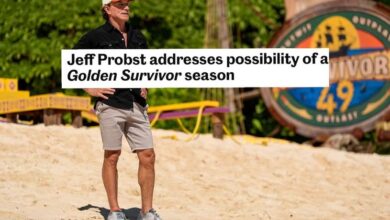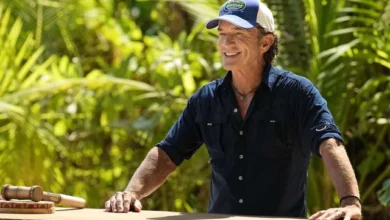
It’s been nearly five years since “Survivor” fans – and players – last heard longtime host Jeff Probst utter the words “Come on in, guys!” ahead of an immunity or reward challenge.
The phrase was once one of the hosts many stalwart “catchphrases” for the series, which similarly included one-liners like, “Drop your buffs,” “The tribe has spoken,” and “Survivors ready.”
During the first season of the “new era,” however, Probst offered the cast of Season 41 the opportunity to weigh in on whether or not he should retire the phrase from his “Survivor” lexicon, arguing that its gendered terminology might be offensive to certain players or viewers at home.
While the majority of the 2021 cast didn’t take issue with the phrase, castaway Ricard Foye – who, at the time, was married to a transgender man who was pregnant with the couple’s second child – ultimately took a stance against its use, telling Probst, “I don’t agree that we should use the word ‘guys’… I fully agree that we should change it, whether it just be dropping the ‘guys’ or changing it to something else… The reality is, ‘Survivor’ has changed over the last 21 years. And those changes have allowed all of us – all of these Brown people, Black people, Asian people, so many queer people – to be here simultaneously.”

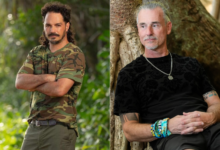


Following Foye’s comments, Probst promptly dropped the “guys” from his catchphrase, and has never looked back; a decision that has led to an ongoing debate within the “Survivor” fandom even five years later.
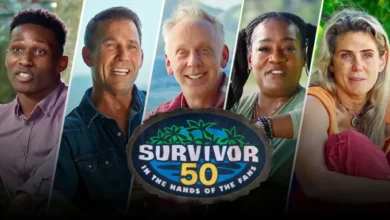
Now, in a new interview with Vanity Fair published in anticipation of the premiere of “Survivor 50: In the Hands of the Fans,” Probst has finally broken his silence on the topic, revealing that the switch was initially suggested by his stepdaughter, Ava.
Probst Responds to Ongoing ‘Come on in, Guys’ Debate
 Getty
Getty“Everybody got upset because I’m too ‘woke’ or whatever, which is irrelevant to me,” Probst said, addressing the controversy that continues to haunt “Survivor” fan sites despite its relative insignificance to the game at large.
Regardless of the backlash, however, the longtime host confirmed that he doesn’t regret the decision, adding, “I don’t care about that. I only care about if I feel like I’m doing the right thing in the right way.”
He added that his decision to drop “guys” from his vocabulary extends beyond the island, telling VF, “I rarely say ‘guys,’” even when the cameras aren’t rolling.
Probst Talks ‘Survivor’ Diversity: ‘Representation Makes a Difference’
The conversation follows a post-COVID shift in the hit CBS series’ diversity initiative, which has resulted in more people of color and LGBTQ+ contestants joining the series in hopes of becoming the next “Sole Survivor.”
While the decision was not made by Probst himself, as a dedicated member of the casting team, he faced backlash regardless, telling VF, “Tons of people complained, and the things they said were distasteful, like, ‘What happened to our show?’”
Though the mandate, which required CBS reality series like “Survivor,” “Big Brother” and “The Amazing Race” to commit to casting 50 percent BIPOC individuals, is no longer in place, Probst and his team have continued to work towards making the series as diverse as possible.
“We took it as a beautiful challenge, and as much as anything in the history of ‘Survivor,’ it changed ‘Survivor,’” the host explained. “It’s absolute proof that representation makes a difference.”
Since making the change, eight of the show’s nine “New Era” winners have been either LGBTQ+ or POC, or both, including Ericka Casupanan (“Survivor 41”), Maryanne Oketch (“Survivor 42”), Yam Yam Arocho (“Survivor 44”), Dee Valladares (“Survivor 45”), Kenzie Petty (“Survivor 46”), Rachel LaMont (“Survivor 47”), Kyle Fraser (“Survivor 48”) and, most recently, Savannah Louie (“Survivor 49”).
It’s important to note that their victories were determined by the juries on their respective seasons, but also that these champions might not have ever gotten the chance to compete under CBS’s former diversity rules.
For Probst, however, the decision has nothing to do with politics, insisting that “Survivor” itself is not, and should not be, a political game.
“We’re just trying to stay in our little bubble,” he concluded.